A camera sees only what the water allows.
Underwater robots can also listen, measure pressure, map the seafloor, and send data back from places people cannot safely reach. That makes them useful for ocean research, pipeline checks, wreck surveys, and work near the seabed.
Quick read
- Sonar can map objects and terrain when light cannot reach them.
- An autonomous underwater vehicle works without a live control cable.
- The hardest problems are power, communication, pressure, and recovery.
What the robot can sense
Light fades quickly underwater, so cameras have a limited range. Sonar sends sound through the water and reads the returning signal. The result can show the shape of the seabed, a submerged structure, or an object hidden by dark water and loose sediment.
A robot can carry more than one sensor on the same mission. A conductivity-temperature-depth sensor records water conditions, while cameras show surface detail. A magnetometer can detect changes linked to metal objects, such as parts of a wreck or buried equipment.
These sensors answer different questions. A camera may show a valve with damage on it, while sonar can show the pipe's position before the robot reaches the site. The data becomes more useful when the systems share the same location and time record.
Two main types of underwater robot
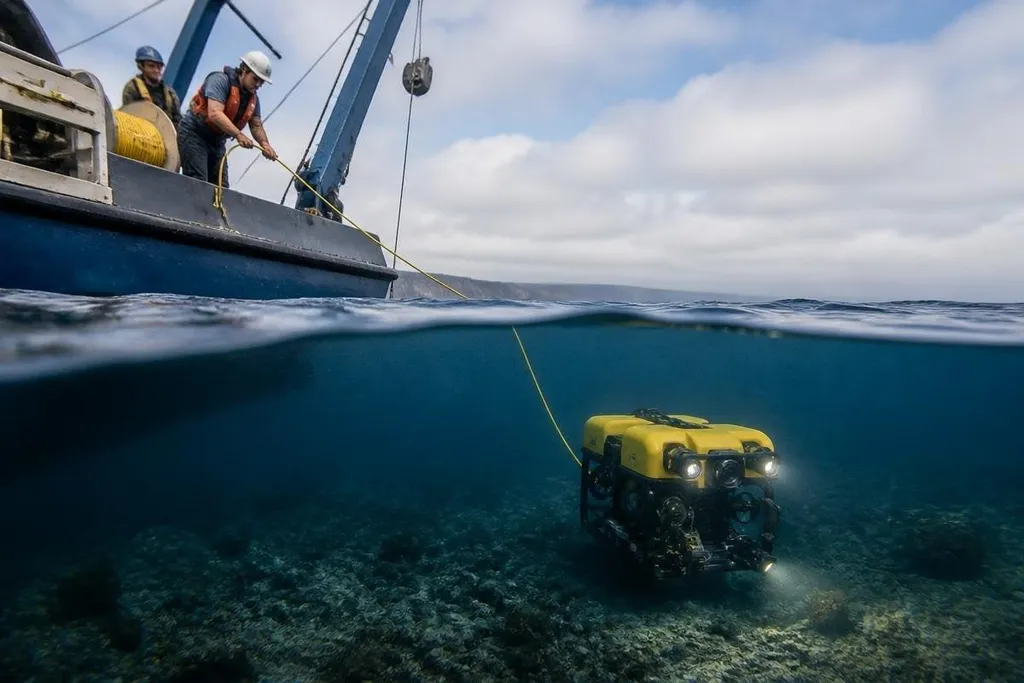
A remotely operated vehicle, or ROV, receives commands through a tether connected to a surface ship. The cable can carry power, video, and control signals. An operator can watch the camera feed and move a thruster or manipulator arm with direct feedback.
That setup suits repair and inspection work. If an ROV finds a loose cable or a damaged cover, the operator can move closer and check the object from several angles. The tether also creates limits: it can catch on structures, restrict range, and require a ship or other surface platform.
An autonomous underwater vehicle, or AUV, follows a planned route without a live control cable. It uses sensors, stored instructions, and an onboard computer to keep moving and collect data. AUVs can cover areas where a tether would be hard to manage, but they must return with their data and reach a recovery point.
The difference matters when you plan a mission. An ROV gives people more control during the task. An AUV reduces the need for a continuous link to the surface, but a fault can wait until the vehicle is recovered.
Why communication is hard below the surface
Radio signals that work well in air travel poorly through seawater. Below the surface, robots often use acoustic signals for limited communication, while high-rate video usually needs a cable or storage onboard the vehicle.
That changes how operators work. An ROV can send live images through its tether, but an AUV may record hours of data and transmit only short status messages during the mission. The robot must also estimate its position because satellite navigation does not work below the surface.
A navigation system may combine sonar, motion sensors, depth readings, and a map of the seafloor. Small position errors can grow over a long route, so the mission plan needs clear limits and a safe return point.
An underwater robot can collect data far below a ship, but its report still needs the mission site, depth, task, and date. Robot24 can connect those details to named machines and ocean trials before the next section looks at the limits that make deep-water work hard.
What still limits the work
Pressure rises with depth, so the robot needs sealed housings, suitable materials, and careful checks before launch. Water can enter through a damaged seal, a connector, or a crack that was too small to see during a quick inspection.
Power is another limit. Thrusters, lights, computers, and sensors all draw from the same supply. A mission that spends too much energy fighting currents may return with less data than planned, even if every sensor works.
Recovery can also decide whether the mission succeeds. A vehicle that reaches the right location but cannot find its recovery point has not finished the job. This is why teams plan launch, route, abort, and recovery steps together.
A practical choice before a mission
Use this short check before choosing an ROV or AUV:
- Need live video? Choose a tethered ROV when an operator must guide the work.
- Need wide-area mapping? Consider an AUV when the route can be planned in advance.
- Need physical work? Check the manipulator arm, grip force, reach, and tool support.
- Need measured water data? Confirm that the payload includes the required depth and water sensors.
- Need a safe return? Plan recovery space, surface support, and an abort route before launch.
I'd choose the robot around the question being asked, not around the most impressive sensor list. A vehicle built for seabed mapping may be a poor choice for repair work, even if it carries a camera and sonar.
The open question is how much ocean data teams can collect before power, communication, and recovery costs outweigh the value of another mission. Underwater robots will answer that by returning with better maps, longer records, and fewer gaps in the places ships and divers cannot reach.